
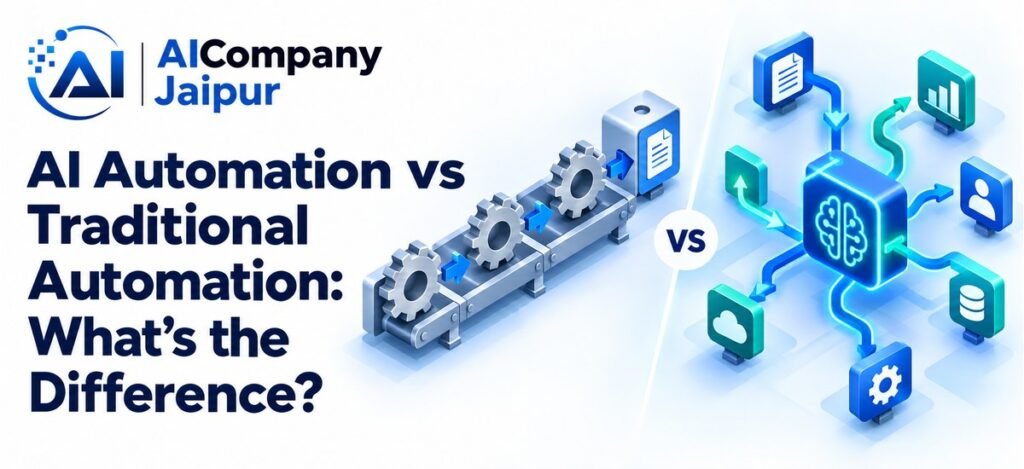
AI automation vs traditional automation is a question about how a system decides what to do. Traditional automation follows rules defined in advance. AI automation introduces models that interpret information, recognise patterns, or generate outputs within a workflow.
Both can save manual effort, but they suit different tasks. A scheduled invoice reminder usually needs a clear rule. Understanding a customer’s loosely written complaint may require language processing.
For business owners, the useful question is which parts of a process need predictable rules and which need interpretation. Choosing carefully can avoid unnecessary costs and make the result easier to manage.
What Is Traditional Automation?
Traditional automation executes predefined instructions when specified conditions occur. A trigger starts the workflow, rules determine the next steps, and software performs the configured actions.
Examples include sending a confirmation after a form submission, calculating tax using approved rules, or transferring an order between two systems.
A rule might say: if an invoice remains unpaid after the due date, prepare a reminder. The process does not need to infer customer intent or invent new steps.
Traditional automation can use APIs, workflow software, scripts, or robotic process automation. The implementation varies, but the governing logic is explicitly defined.
It works especially well when inputs are consistent and exceptions are understood.
What Is AI Automation?
AI automation uses an artificial intelligence model for one or more steps in a business process. The model might categorise text, extract document details, predict an outcome, or draft a response.
Consider an inbox receiving order enquiries, complaints, and supplier notices. An AI classifier can suggest a category from the message content, even when people use different wording.
The surrounding software can then route the message according to ordinary rules. AI does not have to control the entire process.
IBM’s explanation of intelligent automation describes combining AI with business process management and robotic process automation. That combination is useful when a workflow contains both interpretation and repeatable execution.
The Main Differences
| Comparison | Traditional automation | AI automation |
|---|---|---|
| Decision method | Explicit conditions and rules | Model-based interpretation or prediction |
| Typical inputs | Consistent fields and known formats | May include varied text, images, or documents |
| Output behaviour | Generally repeatable under the same conditions | May vary or contain model errors |
| Maintenance | Update rules and integrations | Also evaluate model behaviour and data changes |
| Validation | Test conditions and expected results | Also test representative and difficult examples |
These are broad distinctions, not absolute boundaries. A traditional workflow can be complex, and an AI workflow can be tightly restricted. Both can fail when integrations break or inputs change.
Difference 1: Handling Varied Information
Structured information has a known format, such as an order form with separate fields for a name, quantity, and product code. Rule-based software can read those fields directly.
Unstructured information is less predictable. A customer may describe the same issue in a paragraph, photograph, or voice message.
AI can help interpret that variation. However, it still needs testing against the actual languages, document quality, and terminology your customers use.
For example, a logistics business might receive delivery instructions in Hindi, English, and mixed-language messages. A model could extract a suggested delivery request, while staff confirm ambiguous locations or unusual requirements.
Difference 2: Reliability and Explainability
A rule-based action is often easy to explain: the order value exceeded a threshold, so the system requested approval. Troubleshooting can trace the rule and its input.
AI outputs can be harder to explain in the same way. A generated answer may look convincing despite containing incorrect facts.
Use checks around AI results. Compare extracted totals with line items, restrict categories to an approved list, and require sources for document-based answers.
Asking a language model how confident it feels is not a substitute for testing. Confidence scores require validation before they can support operational decisions.
Difference 3: Setup and Ongoing Cost
Traditional automation may involve mapping fields, defining rules, and connecting systems. Complex integrations can still require substantial development.
AI automation adds work such as preparing examples, evaluating outputs, managing provider settings, and monitoring quality. Depending on the tool, costs may increase with usage or document volume.
Neither approach is automatically cheaper. Compare the total cost of running the process, including staff review and error recovery.
If a deterministic rule solves the problem accurately, adding a model may bring little value. If varied documents create hours of manual entry, a tested extraction step may justify its additional complexity.
Difference 4: Responding to Change
A common assumption is that AI automatically learns from every correction. That depends on the system. Many deployed tools do not update their underlying models when an employee edits an answer.
Changing a prompt, updating a knowledge base, and retraining a model are different activities. Each needs an appropriate review process.
Traditional automation also needs maintenance when business rules change. A new discount policy or altered form can require configuration updates.
Whichever approach you use, assign an owner to check that the workflow still reflects current business requirements.
Why a Combined Workflow Often Makes Sense
Imagine a supplier invoice process:
- AI extracts the invoice fields into a review screen.
- Rules check mandatory fields, calculations, and duplicate numbers.
- An employee resolves uncertain details.
- The accounting integration creates a draft record.
- A separate approval process authorises payment.
Each component has a limited responsibility. The model handles document variation, rules perform precise checks, and people approve consequential actions.
This design also makes failure recovery clearer. If extraction fails, the invoice can return to manual entry without stopping unrelated accounting work.
How to Choose for Your Business
Start by describing the task in plain language. Identify the inputs, the expected output, and what a mistake would cost.
- Choose rules for fixed calculations, scheduled actions, and known conditions.
- Consider AI for varied language, document interpretation, or useful pattern detection.
- Combine them when the process includes both.
- Keep approval controls for payments, commitments, and sensitive decisions.
Test a representative sample before expanding. Measure accuracy, processing time, manual corrections, total cost, and recovery from errors.
For risk planning, the NIST AI Risk Management Framework provides a reference for evaluating and managing AI systems.
Frequently Asked Questions
Is AI automation always better?
No. A fixed rule is often preferable when the task has clear conditions and exact outputs. AI is useful when interpretation adds measurable value.
Can traditional automation include RPA?
Yes. RPA can execute predefined interactions with software. It can also be combined with AI-assisted extraction or classification.
Does AI automation need human supervision?
The required oversight depends on the task and consequences of mistakes. Begin with reviewed outputs and reduce supervision only when evidence and controls support it.
Conclusion
The difference between AI automation and traditional automation lies in the work assigned to rules and models. Predictable steps benefit from explicit logic; varied information may benefit from tested interpretation.
Map the workflow before selecting technology. If you need help making that decision, discuss your automation requirements with AI Company Jaipur.