In 2026, businesses are increasingly exploring agentic AI, a class of artificial intelligence systems that can understand goals, plan several steps ahead, use tools, make decisions, and act with minimal human assistance.
Instead of waiting for a person to coordinate each step manually, an agent can research information, update CRM, communicate with customers, analyze data, trigger workflows, and report the outcome.
Microsoft’s 2026 Work Trend Index describes a growing shift toward human-agent collaboration, while its research shows that organizations are still working through the gap between individual AI readiness and organizational capability. This makes 2026 an important year for businesses considering Agentic AI development.
What Is Agentic AI?
Agentic AI is the term used to describe artificial intelligence systems that are capable of pursuing a defined objective by reasoning about a task, planning actions, interacting with tools or software, evaluating results, and adjusting their approach when necessary. IBM describes agentic AI as systems capable of accomplishing specific goals with limited supervision, combining autonomy, adaptability, and coordinated AI agents.
The easiest way to understand it is to compare an AI assistant with an AI agent. A conventional chatbot may answer, “Here are five potential customers.” An agentic system could identify potential customers, research their businesses, qualify them against predefined criteria, update a CRM, prepare personalized outreach, and send the information to a salesperson for approval.
In real business environments, the best AI agents for business often work within permissions, policies, approval checkpoints, and predefined boundaries. Human employees remain responsible for decisions where judgment, compliance, relationships, or financial risk matter.
How Does Agentic AI Work?
An Agentic AI system typically follows a cycle of perception, reasoning, planning, action, evaluation, and adjustment. The exact architecture differs between solutions, but the basic concept is similar.
First, the agent receives a goal and gathers relevant context. It then determines what needs to happen and creates a sequence of actions. The system can call external tools, APIs, databases, enterprise software, search systems, or other agents to complete individual steps.
After an action is completed, the agent evaluates the result. If the result is incomplete or unexpected, it can revise its plan and try another permitted approach.
This ability to reason and act across multiple steps separates agentic AI from simple prompt-response applications.
Key Components of Agentic AI
A reliable Agentic AI solution usually combines several technologies rather than depending on a single AI model. Agentic AI is more than an AI model—it is a complete system designed to understand goals, make decisions, use tools, and complete tasks.
Its core components include LLMs and reasoning models for intelligence, memory and context management for continuity, and planning mechanisms for breaking complex goals into actionable steps. APIs and business tools connect agents with CRMs, databases, and other software, while knowledge retrieval provides relevant information. Workflow orchestration coordinates multiple agents, and security, permissions, human approval, monitoring, and evaluation keep operations reliable.
Together, these components transform AI from a simple assistant into an intelligent digital workforce.
Agentic AI vs Generative AI vs Traditional Automation
|
Feature |
Traditional Automation | Generative AI |
Agentic AI |
| Main capability | Executes predefined rules | Generates content or responses | Pursues goals and performs actions |
| Decision-making | Rule-based | Usually prompt-driven | Context and goal-driven |
| Flexibility | Low to moderate | High for generation | High within defined boundaries |
| Tool usage | Preconfigured | Sometimes available | Core capability |
| Multi-step tasks | Limited | Usually user-directed | Designed for multi-step execution |
| Human involvement | Often required for exceptions | Common | Can be reduced but should remain for high-risk actions |
The important point is that Agentic AI does not necessarily replace automation or generative AI. Instead, it can combine them. An agent might use generative AI to create a message, traditional automation to trigger an invoice, and APIs to update a CRM.
Key Benefits of Agentic AI for Businesses
Agentic AI solutions for businesses can turn complex, repetitive workflows into smart, automated processes. Instead of employees manually collecting data, checking information, updating systems, and following up, AI agents can handle multiple connected tasks with minimal supervision. This helps businesses achieve faster operations, 24/7 support, fewer repetitive tasks, better productivity, and quicker customer responses.
Businesses can also scale operations without increasing workload at the same pace. Whether it is customer service, sales, finance, HR, or operations, Agentic AI automation can help teams work smarter, respond faster, and deliver more consistent results.
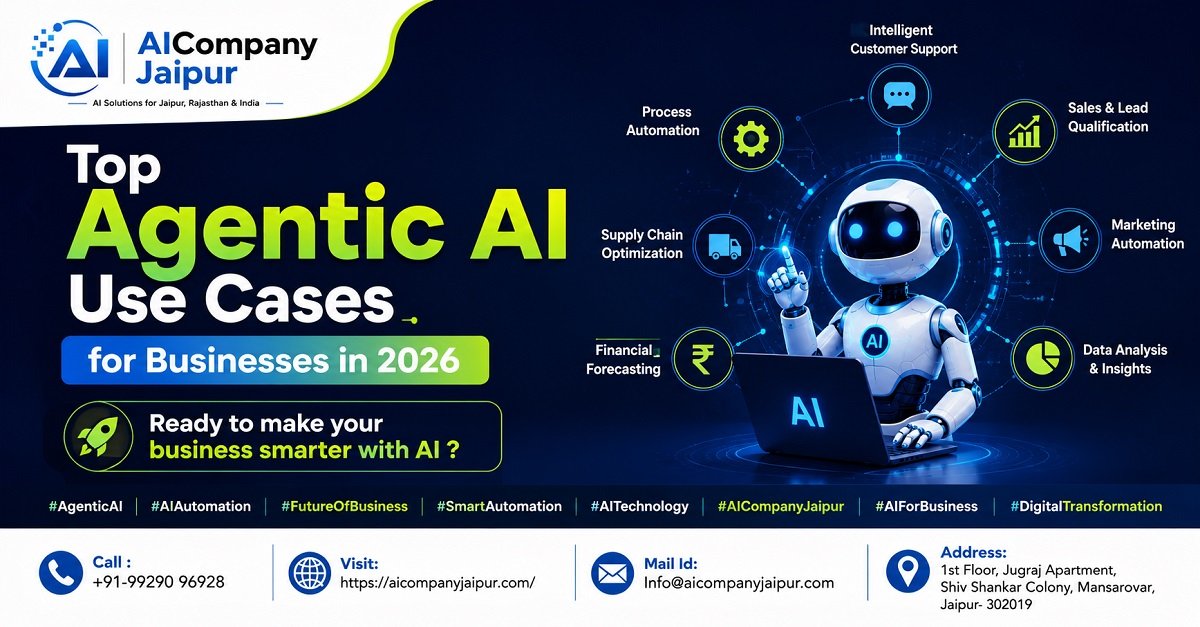
Top Agentic AI Use Cases for Businesses in 2026
Businesses can use AI agent development services to automate workflows where information, decisions, and actions are connected. Here are practical, real-world use cases across major business functions:
1. Customer Service
AI agents can understand customer queries, access order or account information, resolve common issues, create support tickets, and escalate complex cases to human representatives.
2. Sales & Lead Generation
AI agents can research prospects, qualify leads using predefined criteria, update CRM records, identify buying signals, and prepare personalized follow-up messages for sales teams.
3. Marketing
Marketing agents can analyze campaign performance, research competitors, identify content opportunities, create campaign drafts, segment audiences, and recommend actions based on customer behavior.
4. Finance & Accounting
Finance agents can process invoices, match purchase orders, identify payment discrepancies, categorize expenses, prepare financial summaries, and flag unusual transactions for human review.
5. Human Resources
HR agents can screen employee queries, assist with onboarding, collect required documents, schedule interviews, answer policy questions, and guide employees through routine HR processes.
6. IT & Technical Support
IT agents can monitor systems, analyze alerts, troubleshoot common technical issues, create service tickets, recommend solutions, and escalate critical incidents to IT professionals.
7. Operations Management
Operational agents can monitor workflows, coordinate tasks between departments, track process delays, identify exceptions, update systems, and recommend corrective actions to improve efficiency.
8. Supply Chain & Logistics
Supply-chain agents can monitor inventory levels, track shipments, identify delivery delays, communicate with suppliers, forecast replenishment needs, and alert teams about potential disruptions.
9. E-commerce
E-commerce agents can recommend products, answer customer questions, monitor abandoned carts, process routine order requests, track deliveries, and personalize shopping experiences using customer data.
10. Healthcare Administration
Healthcare agents can assist with appointment scheduling, patient inquiries, documentation workflows, insurance-related processes, and administrative coordination while keeping sensitive decisions under human supervision.
11. Real Estate
Real-estate agents can qualify property leads, match buyers with suitable listings, schedule property visits, answer common questions, update CRM systems, and automate follow-up communication.
12. Market Research
Research agents can gather information from approved sources, analyze competitors, summarize industry developments, identify market trends, and prepare structured research reports for business decision-makers.
13. Document Processing
Document-processing agents can extract information from invoices, contracts, forms, and applications, validate data against business rules, classify documents, and route exceptions to employees.
14. Software Development
AI coding agents can analyze requirements, generate code, review changes, identify potential bugs, write tests, update documentation, and assist developers throughout the software development lifecycle.
15. Procurement
Procurement agents can compare supplier information, analyze purchasing requirements, identify suitable vendors, prepare purchase requests, monitor orders, and alert teams when supplier issues arise.
16. Legal & Compliance
Compliance agents can review documents against predefined policies, identify potential compliance issues, organize regulatory information, generate summaries, and route high-risk cases to qualified professionals.
17. Banking & Financial Services
AI agents can assist with customer inquiries, transaction monitoring, document verification, financial-service workflows, and case management while applying strict security, compliance, and human-approval controls.
18. Education
Education agents can answer student questions, assist with course information, automate administrative requests, schedule appointments, organize learning resources, and support teachers with routine documentation.
19. Hospitality & Travel
Hospitality agents can manage booking inquiries, recommend services, answer guest questions, coordinate requests with hotel teams, and provide personalized assistance throughout the customer journey.
20. Manufacturing
Manufacturing agents can monitor production data, identify operational anomalies, coordinate maintenance requests, track inventory, summarize production performance, and alert managers when predefined thresholds are exceeded.
What Are the Challenges and Risks of Agentic AI?
While Agentic AI can transform business operations, greater autonomy also brings greater responsibility. But AI agents may make incorrect decisions, access sensitive information, misuse connected tools, or produce unreliable results if they are poorly designed or monitored. Risks such as data privacy, prompt injection, security gaps, inaccurate reasoning, and excessive permissions should never be overlooked.
The solution is responsible Agentic AI development with strong safeguards from day one. Businesses should use role-based access, secure data controls, regular testing, audit logs, human approvals, continuous monitoring, and clear action limits.
Simply put, the more powerful an AI agent’s actions are, the stronger the human oversight should be.
Why Choose AICompany Jaipur for the Best Agentic AI Development Services?
Looking for Agentic AI development in Jaipur? AICompany Jaipur helps businesses turn complex workflows into smarter, automated processes. From AI agent development and workflow automation to intelligent assistants, API integrations, and custom AI solutions, we focus on building practical systems that solve real business challenges. Our approach connects AI with your existing tools, data, and processes to create solutions that are scalable, secure, and results-driven.
With AICompany Jaipur, you get more than an AI model—you get a business-focused technology partner. We first understand your workflow, identify the right automation opportunities, build the solution, and continuously improve its performance. Start with one high-impact use case and turn AI into a smarter digital workforce.
Final Thoughts
Agentic AI is reshaping the future of business automation, helping companies move beyond simple AI responses toward intelligent systems that can plan, reason, use tools, and complete tasks. In 2026, the goal isn’t to replace people—it’s to create a smarter partnership where AI agents handle repetitive work while teams focus on strategy, creativity, and important decisions.
The best approach is to start small, choose a high-value workflow, set clear goals, and maintain strong human oversight. Ready to make your business smarter with AI? Contact AICompany Jaipur, which delivers customized Agentic AI solutions, AI agent development, and intelligent automation designed around your business needs.
Frequently Asked Questions About Agentic AI
1. What is Agentic AI in simple terms?
Agentic AI is AI that can work toward a goal by planning tasks, using tools, making decisions, and taking actions with limited human supervision.
2. What is the difference between Agentic AI and generative AI?
Generative AI primarily creates content such as text, images, or code in response to instructions. Agentic AI can use generative models as part of a larger system that plans and executes multi-step tasks.
3. Can small businesses use AI agents?
Yes. Small businesses can use AI agents for customer support, lead qualification, appointment management, reporting, research, CRM updates, and other repetitive workflows. Starting with one high-value process is generally more practical than automating everything at once.
4. Is Agentic AI fully autonomous?
Not necessarily. A well-designed business agent should operate within defined permissions and policies. High-risk activities can require human approval, while lower-risk tasks may be automated more extensively.
5. How can I get Agentic AI development services in Jaipur?
Businesses can work with an experienced AI agent development company in Jaipur to identify suitable workflows, design the agent architecture, integrate business systems, implement security controls, and deploy the solution gradually.